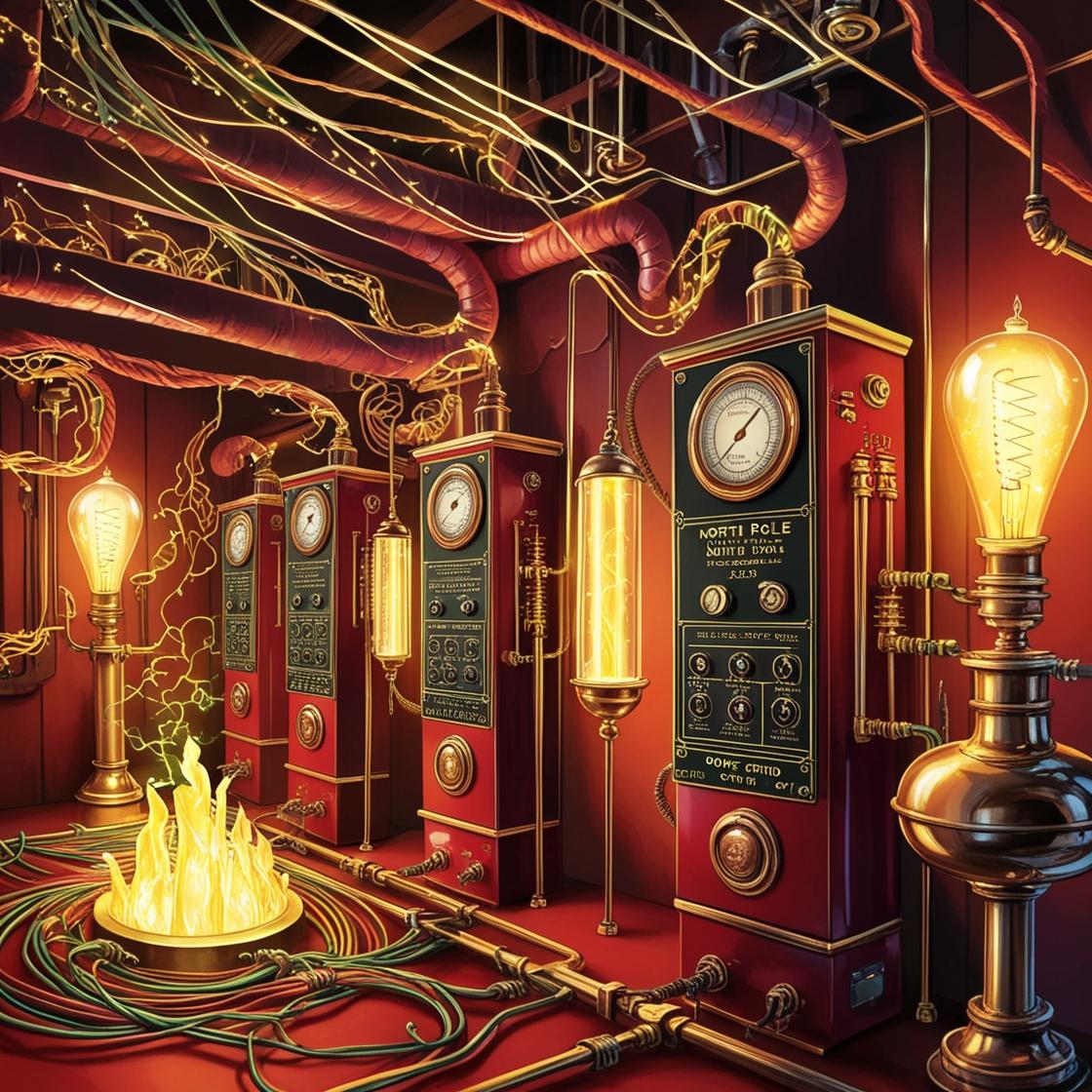
The North Pole’s power grid hummed in the icy air, its lights flickering ever so slightly—a reminder of the delicate balance required to keep Santa’s workshop, the sleigh systems, and the reindeer stables running smoothly. Helmi stood in the control room, staring at the dashboard covered in graphs and warning lights. The shift to renewable energy sources had made grid stabilization a nightmare. Digital solutions, once heralded as the future, were overwhelmed by the sheer scale and complexity of the modern system. “The grid’s problems are too big, and these systems are too small,” Helmi muttered.
Their mind wandered to the analog Network Analyzers of old—massive systems that modeled power grids in real time using electrical circuits to mimic the behavior of the grid itself. They were fast, reliable, and perfect for large-scale problems, but had fallen out of use in favor of digital simulations. “Maybe it’s time to bring them back,” Helmi thought, sketching a modernized version.
By evening, Helmi had built a new analog grid stabilizer. This device used advanced analog circuits to replicate the grid’s dynamics in real time, instantly identifying imbalances and redirecting energy flows before disruptions could occur. It required no complex programming and ran on minimal power—an elegant solution for a complex problem.
As the flickering stopped and the workshop lights steadied, Helmi smiled. “Sometimes, the old ways just need a modern twist,” they said, jotting a note for Santa: Grid stable, Christmas secure.
